While in Nepal, the food was sort of north Indian food, yet
every one of our team missed good ,hot dishes of south Indian taste. To an
extent the meals were good as we had plenty of good thick curds. Because in
2005 we had to face the nature's fury of snow blizzard, in 2006 we went on June
30th, and came back by July 20th. of all the three years we went, 2006 was the
most appropriate time for us, both climatically and physically....... …(This
year 2007. we went on June 19th and came back on July 6th.we were 73 pilgrims,
this time, the largest group in all these three years, and there was a boy of
21 to a venerable 72 year old with us. And we had known on our return to Nepal that here at India most of the southern states
were reeling under the fury of rain too. While returning, some of the rivers
were in spate, and the whole ribbon of water stretched out below, making one
wonder about the fury of Nature!)
The next day, there
was a small briefing, and getting to know all the other fellow travelers. some
were acquaintances, and some where from Madhya Pradesh, Ahmmedbad, Gujarat, and
some from Madras and some from Hyderabad too. A list of essential items to
be stocked by the pilgrim was given and off all went for a shopping. It is fun
to think back, that even though the rusty hindi is seldom used when in ones
home state once you go up to North, the language automatically comes, anyway,
enough to make the sellers, porters and all to understand. And then, on the
third day, the journey starts by 5Am.
For the first lap of journey , it is through Nepal itself to the border, where
the passport and visa and documents are verified and then the real journey
starts. After a lengthy drive of about 6 hours, all arrive at the border,
Kodari, and here is the Friendship bridge,built, sponsored by both Tibet/china
and Nepal. After a hasty lunch is eaten,
and then by 11.30am all
start, for then, the time set is changed, for in Tibet the watches are 2.1/2 hours
back than Indian standard time. So though we reach Zangmo, the Tibetan village
occupied by Chinese by 12 pm
where the Chinese have their passport verification office, the time as per
their watches is 10.30am.
In a jiffy 2.1/2 hours are gone! It takes about two hours just to get the
verification start, and the queue lengthens. In a very curt manner the
passports are checked ( in 2005 the verification and all was very much time
consuming and also the Chinese officials were curt to a point, but both last
year and this year , though the queue is lengthy, verification lengthy, the
curt manner is slowly replacing to a sort of cheery countenance. and it is from
here the Chinese guide gets the pre ordered
sherpas and vehicles allotted for this journey. It is a four wheel van
with left-hand driving, and the drivers and vehicles we got were very
excellent. Now a 30 kmts journey to Nyalam, which is 3750mtr above sea level,
and one and a half days stay there for acclimatizing. In 2005 and 2006, we
could get to Nyalam that day it self, But this third time 2007 there is a
difference. The Tour manager says we have to rest in Zangmo till 12pm, as the roads ahead are being
repaired and traffic stopped. It is only during the night for two, three hours
the traffic is resumed. And while we were waiting in the cars for the road to
clear, we could see many tanks like vehicles, that is where the wheels should
be there is sort of revolving chain like wheels, and many heavy vehicles
transporting big machinery. (It is amazing the way new building and lodgings
have come up both in Zangmo and Nyaalam. The Zangmo is a small township with too many shops run by the
Chinese and only two hotels were seen there run by Sherpas, and most of the
hoteliers, merchants are Chinese too. But you can see the Tibetans too… they
present a sorry lot, a very sorry lot. Though they are in their own land, they
are forced to live as riff raffs. While
the Chinese youths are smartly dressed and moves with assurance, the Tibetan
youths are either sitting huddled in some corner, or moving about, but with
doubt, as though they don’t belong here. Theirs is the body language of the
defeated. Yet, some times there are others with smoldering eyes too,
defiant. . They walk about doing only
the menial works, just one or two shops there run by Tibetans, but, everywhere
the laborers are Tibetans. While driving, slowly the shops and hotels and eateries
change, the small dwellings and shanties of Tibetans are seen both sides of the
roads, and then after sometime, nothing. Only the river to the left, it is
called Indraavathy, foaming, and the
road twisting and turning, mountains begin to loom up, and the trees and big
shrubs begin to make over to small shrubs and gradually, not a single tree can
be seen. Waterfalls are many in the initial run, some breathtakingly beautiful,
and one crashed to the valley below through a tunnel above the road. The landscape
begins to change too. Rolling hills with mountains on the background are seen,
and arriving Nyalam, the first icecap donned mountain can be seen in the
distance The chill begins to be felt by now. The sweaters and shawls are not
sufficient. There is something sharp in the air. May be the air is getting
rarified. And the rooms are all just small cubicles, with four persons to
share. Only one window, which is kept shut whole day. All take a walk in the
roads. There is only the floating population of the trekkers and pilgrims. Only
some shops, eateries, and some hotels coming up .But there are many liquor
shops. Though the shops are all in Chinese letters, there is no missing the
advertisements. ( By this time may be the authorities have become wise to build
as many hotels as possible, considering the enormous revenues it brings ) This
third time the one difference I have noted that changes have come very fast to
this alien world. Where last year only bare lands stretched out, now there are
so many mud buildings built within a compound, and in some places even a sort
of Tibetan stupa is also seen. /almost as though the Chinese are wooing the
Tibetans back, but defenatly for their own ends. Only Tibetan girls, women and
old men are seen, and I wondered how it is so. But the answer was round the
very next bend. The meandering ways through the Land cruisers used to run has
been changed to roads, what if untarred, still it is a road. Electric poles are
seen, also telephone poles. Most of the missing men folks and youths are
working there, with the Chinese supervising. Even small settlements with mud huts and compound wall
with a chorten are seen constructed.) A
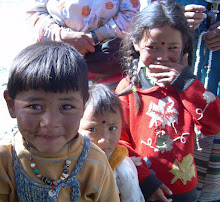
Tibetan family is coming opposite us. Father, Mother and child. Father is
attired in pants and sort of tea shirt, with shabby sweater or coat thrown over
it. A monkey cap is also worn. He is wearing earrings too. The woman, has
plaited hair, wears their traditional dress, wearing one like a dhothy and over
that colored woolen apron like dress. It is called ghoo. She has many stone
necklaces in her throats, hands and ears too. The child is a chubby girl, very
cute, but we almost wonder how that child can be so dirty!! It may be because I
keep on forgetting theirs is a very cold country plus, they are outsiders in
their own country with nothing to support them, so how can they be clean and
healthy? Her cheeks are red and round, hair in two small braids, and wears
clothes shoes. She too has some sort of necklace round her neck, and a very
shabby woolen coat. On seeing us Indians, they ask for Bindies(the round dot of
vermillion we wear on forehead)We gave the child and mother too, bindy, and
managed to take a photo too. By now the wind begins to get more colder and
rough too. With teeth chattering we manage to reach the rooms. The dinner is
served by the Sherpas. A sort of briefing also takes place by the travel groups
who are taking us to Kailas. The need of warm
clothing’s, the need to pay close attention to details, providing horses or
yaks to the needy and what to do while in parikrama all explicitly explained. A
sort of awe is there in imagining what to expect there!! The leader came to us
shortly and told we would be starting the journey very early next morning as we
have to cover a long distance to Saga which is 4740mts above sea level.

അഭിപ്രായങ്ങളൊന്നുമില്ല:
ഒരു അഭിപ്രായം പോസ്റ്റ് ചെയ്യൂ